
The auto refractometer is most widely used instruments in modern eye‑care clinics and optical shops. It provides fast, objective measurements of a patient’s refractive status, helping professionals understand whether someone needs glasses or contact lenses. This blog will practical explanation of what an auto refractometer is, how it works, how professionals use it?
What Is an Auto Refractometer?
An Auto Refractometer (or Autorefractor) is a computer-controlled medical device used to provide an objective measurement of a person’s refractive error. It determines the prescription needed for glasses or contact lenses by measuring how light is changed as it enters the eye.
Unlike traditional subjective refraction, which requires a patient to answer “which is better, one or two?”, the auto refractometer gives the eye doctor a highly accurate starting point in just a few seconds.
How Does an Auto Refractometer Work?
The working principle of an auto refractometer involves projecting an infrared light beam into the eye. This light reflects off the retina and returns to the device, where sensors analyze the reflected light patterns.
The key steps include:
Light Projection: The machine emits a low-intensity infrared light into the eye.
Reflection Detection: The light reflects off the retina and returns through the optical media.
Data Analysis: Sensors measure changes in the reflected light’s angle and focus.
Measurement: The device measures how the light changes as it bounces back, determining the eye’s refractive power in different directions (meridians).
Calculation: A computer uses these measurements to calculate an estimated prescription, including the sphere, cylinder, and axis for glasses.
This process typically takes only a few seconds per eye, providing sphere, cylinder, and axis values essential for prescription formulation.
Step-by-Step: How to Use an Auto Refractometer?
Using an auto refractometer is a non-invasive, painless process that typically takes less than a minute per patient.
Step 1: Positioning: Have the patient sit comfortably and place their chin on the chin rest and their forehead against the headbar.
Step 2: Fixation: Instruct the patient to look at the internal visual target (often a “guided cloud map” or an image of a hot air balloon). This target helps the eye relax and prevents “proximal accommodation,” which can skew results.
Step 3: Alignment: The operator uses a joystick or touchscreen to align the machine with the patient’s pupil. High-end machines often feature auto-tracking to find the eye automatically.
Step 4: Measurement: Once aligned, the machine takes several readings (usually three per eye) and averages them to ensure the highest accuracy.
Step 5: Printing: The results are instantly printed via a built-in thermal printer, providing the Sphere, Cylinder, and Axis measurements.
Key Uses & Benefits
Auto refractometers offer several advantages for clinics, optical shops, mobile eye‑care teams, and hospitals.
- Baseline Prescription: Gives optometrists an accurate initial estimate for your prescription.
- Efficiency: Saves time in busy clinics.
- Objective Data: Provides an unbiased measurement, useful for subjective testing.
- Pediatrics: Ideal for children or those who can’t communicate well, as it requires minimal patient input.
- Vision Screening: Used in schools and mobile clinics for quick checks
For clinics focusing on efficiency and accuracy, an auto refractor is essential equipment.
Recommended Model in 2025: ARK‑4000 Auto Refractometer
If you are looking to upgrade your clinic, the ARK-4000 Auto Refractometer/Keratometer is a top-tier recommendation.
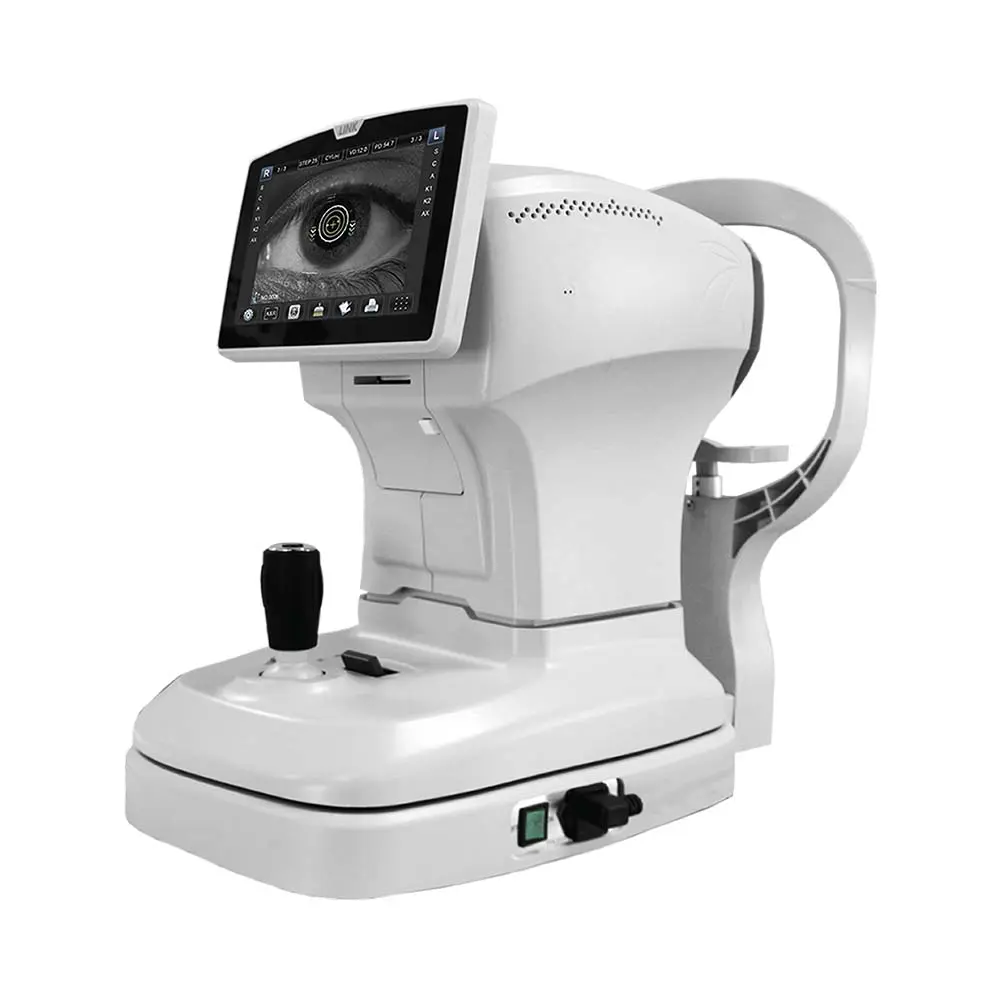
Key Features of the ARK-4000:
Enhanced Precision: The upgraded measurement engine improves both precision and repeatability. It is particularly effective for patients with small pupils or those who struggle with unsteady fixation.
Adjustable 7” Touchscreen: The high-resolution display can be adjusted to various angles. This flexibility supports both seated and standing operations, making it comfortable for any practitioner.
Optimized Workflow: Designed for speed, the machine handles high-traffic environments with ease, providing consistent results without a steep learning curve for staff.
Seamless Data Management: Includes a built-in printer and easy data export capabilities, allowing for smooth integration into your digital health record systems.
Professional Aesthetics: With its clean, modern design, the ARK-4000 enhances the professional look of premium clinics and exam rooms.
Benefits of Using an Auto Refractometer
- Speed: Rapid measurements reduce patient wait times.
- Objectivity: Minimizes subjective bias inherent in manual refraction.
- Ease of Use: Simplifies the refractive assessment process, enabling use by trained technicians.
- Versatility: Suitable for a wide range of patients, including children and those with communication difficulties.
- Data Integration: Compatible with electronic medical records and optical lab machinery for streamlined workflows.
Expert Perspective
Dr. Zhang Hui, an experienced ophthalmologist, notes:
“Auto refractometers like the ARK 4000 are indispensable in modern eye care. They provide quick, accurate assessments that form the foundation for effective treatment plans.”
Conclusion
The auto refractometer is no longer a luxury—it’s a clinical necessity. By delivering fast, objective data, it enhances diagnostic accuracy while improving patient throughput. When paired with a certified, service-backed device like the ARK-4000, your practice gains both technological advantage and long-term reliability.
FAQs
1. Can an auto refractometer replace manual refraction completely?
No, an auto refractometer cannot completely replace manual refraction. The automated measurement serves as a valuable starting point or screening tool for eye care professionals, who then refine the prescription through subjective, manual testing.
2. Is the ARK 4000 suitable for pediatric patients?
Yes, its fast and non-invasive operation is ideal for children.
3. how accurate is auto refractometer?
Auto refractometers are highly accurate, objective tools providing a strong baseline for refractive error, often within 0.25 to 0.50 diopters of the final prescription, but they measure the eye’s physical state, not subjective comfort; optometrists use them as a starting point, refining the reading with subjective testing (phoropter) to account for brain function and achieve the most comfortable vision, as autorefractor readings alone might miss subtle factors for clear vision. They are very reliable for quick, consistent initial measurements, especially in children or difficult-to-test patients, but require human refinement for the final prescription.


