
In 2026, the phoropter market is hitting a tipping point. While the Manual Phoropter remains the «indestructible classic» (holding 52% of the global market), Auto Phoropters are rapidly becoming the industry standard due to labor shortages and the rise of telehealth.Here is your 2026 buying guide to navigating the choice between mechanical reliability and digital efficiency.
What is a Phoropter?
The phoropter (or refractor) is a sophisticated instrument used by eye care professionals to determine a patient’s refractive error and precisely measure their eyeglass prescription. It often referred to as a «space-age visor» or «mask,» this device is packed with hundreds of different lenses, including spherical, cylindrical, and prism lenses, which can be quickly adjusted to measure refractive errors, such as nearsightedness, farsightedness, and astigmatism. It is a, if not the, primary diagnostic instrument used by eye care professionals during a comprehensive eye exam to determine a person’s exact eye prescription.
History:
The phoropter has been used since the early 1900s, originally called a «phoro-optometer» and designed for both refraction and, as its name suggests, to measure phorias (eye coordination).
How the process works:
- Sitting and Looking: You sit behind the phoropter, looking through it at a distant eye chart (visual acuity chart).
- Sphere Adjustment (Focus): The doctor starts with a general lens and then rotates lenses (spherical power) to correct your distance focus, asking you to compare options like «one or two» for clarity.
- Cylinder Adjustment (Astigmatism): Once the sphere is set, the doctor introduces cylindrical lenses to correct for astigmatism, asking you to choose the clearer image as they adjust the cylinder power and axis (orientation).
- Axis Refinement: Fine adjustments are made to the cylinder axis (degrees) until the image is consistently sharp.
- Binocular Vision: The phoropter also tests how well your eyes work together (binocularity) by introducing prisms.
- Digital vs. Manual: While older phoropters are fully manual, modern ones can be digital, automating some lens changes but still relying on your «one or two» feedback.
What’s the Types of Phoropters?
Phoropter types primarily fall into two categories: traditional Manual Phoropters, operated by the eye doctor turning dials for lens adjustments, and modern Digital/Automated Phoropters, controlled by touchscreens or keypads for faster, data-integrating exams, with some models featuring Plus Cylinder (for ophthalmologists) or Minus Cylinder (for optometrists) setups, all designed to measure refractive errors and binocular vision.
Main Types
- Manual Phoropters: The classic type where the examiner manually rotates lenses and adjusts settings like sphere, cylinder, and axis using knobs and dials, requiring patient feedback for precise correction.
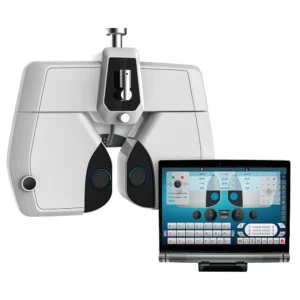
- Digital/Automated Phoropters: Connected to computer systems, these use electronic controls for rapid, precise lens changes, store patient data, and often integrate with auto-refractors and digital chart systems for streamlined exams.
Cylinder Types (Internal Lens Configuration)
- Minus Cylinder Phoropters: Standard for optometrists, using minus cylinder lenses to correct astigmatism.
- Plus Cylinder Phoropters: Commonly used by ophthalmologists and orthoptists, these use plus cylinder lenses; values can be converted to minus cylinder.
Manual Phoropter: Features and Advantages
The Manual Phoropter represents the traditional approach to subjective refraction. These devices are robust, mechanical wonders that have been the workhorse of eye clinics for decades.
Pros of a Manual Phoropter:
- Cost-Effective: Generally, manual phoropters have a significantly lower upfront cost compared to their automated counterparts, making them an attractive option for new practices or those on a tighter budget.
- Durability and Longevity: Built with mechanical components, manual phoropters are often incredibly durable and can last for many years with proper maintenance. They are less susceptible to electronic failures.
- Reliability: Many practitioners appreciate the tactile feedback and direct control offered by a manual phoropter. The mechanical nature means fewer potential software glitches or calibration issues compared to complex electronic systems.
- No Software Updates/Compatibility Issues: Manual devices don’t require software updates or worry about compatibility with other digital equipment, simplifying IT management.
- Familiarity: Many experienced optometrists and ophthalmologists were trained on manual phoropters and may prefer their familiar workflow.
Cons of a Manual Phoropter:
- Slower Process: The manual turning of dials and changing of lenses can make the refraction process slower, especially for patients requiring complex prescriptions or multiple adjustments.
- Operator Dependence: Accuracy heavily relies on the practitioner’s skill, speed, and precision in manipulating the device and recording results.
- Ergonomics: Repeated manual adjustments can be physically taxing for practitioners over a full day of examinations.
- Data Entry: Results must be manually transcribed, increasing the potential for human error and consuming valuable time.
- Limited Integration: They typically don’t integrate seamlessly with electronic health records (EHR) or other digital diagnostic equipment.
Auto Phoropter (Digital Refractor): Features and Advantages
The Auto Phoropter, often referred to as a digital refractor, brings the refraction process into the digital age. These devices are electronically controlled, often operated via a touchscreen console or computer, and can integrate with other digital equipment.
Pros of an Auto Phoropter:
- Speed and Efficiency: Digital control allows for rapid changes in lens power, significantly speeding up the refraction process. This is particularly beneficial for high-volume practices.
- Enhanced Accuracy and Repeatability: Electronic precision minimizes human error in lens changes and data recording. Many auto phoropters also offer guided refraction routines.
- Improved Ergonomics: Practitioners can operate the device from a comfortable position, reducing physical strain.
- Seamless Data Integration: Auto phoropters can often connect directly to EHR systems, automatically transferring prescription data, saving time and reducing transcription errors.
- Patient Comfort: The smoother, quieter, and faster operation can lead to a more comfortable and less fatiguing experience for the patient.
- Advanced Features: Many auto phoropters come with built-in advanced tests for binocular vision, glare testing, and specialized vision functions that manual models might lack.
- Remote Operation: Some advanced models allow for remote operation, which can be advantageous in certain practice setups.
Cons of an Auto Phoropter:
- Higher Upfront Cost: Auto phoropters are a significant investment, often costing several times more than their manual counterparts.
- Maintenance and Repair: Being electronic, they can be more complex to repair and may require specialized technicians. Software updates and potential compatibility issues also need consideration.
- Learning Curve: While intuitive, there is typically a learning curve associated with mastering the digital interface and features.
- Reliance on Power/Electronics: Any power outage or electronic malfunction can halt operations.
2026 Market Comparison
| Feature | Manual Phoropter | Auto (Digital) Phoropter |
| Price (New) | $3,500 – $7,500 | $8,500 – $22,000+ |
| Operational Lifespan | 20+ years | 7–10 years (software/electronics) |
| Refraction Speed | 10–15 minutes | Under 10 minutes |
| Ergonomics | High strain (shoulder/neck) | Low strain (console/tablet based) |
| Data Flow | Manual entry to EMR | Instant bi-directional syncing |
| Key Selling Point | Reliability & «Feel» | Patient «Wow» factor & Speed |
Manual vs Auto Phoropter: Which Should You Choose
Choosing a phoropter in 2026 isn’t about which one “sees better”—both deliver top clinical performance. It’s about matching your workflow and practice vision.
Go manual if you:
- Value the hands-on art of refraction,
- Work in a low-volume or boutique practice,
- Or want a rugged, virtually indestructible device.
It’s still the most cost-effective path to high-quality care.
Go auto if you:
- Are scaling your practice,
- Want to reduce physical strain,
- Or aim for a seamless, paperless digital workflow.
Yes, the upfront cost stings—but the gains in efficiency and patient experience (that “wow” factor) are now the 2026 standard.
Expert Opinion
Dr. Kevin Blant, Senior Optometrist, shares:
«Incorporating Shanghai LINK’s auto phoropters into our clinic has streamlined our refraction process without compromising accuracy. The digital integration saves time and enhances patient flow.»
Popular Recommendations
Conclusion
Both manual and auto models deliver excellent clinical results. 2026, choose manual for hands-on control, simplicity, and long-term reliability, especially in smaller or specialty settings. Opt for auto if you’re building a high-efficiency, digital-first practice where workflow integration, ergonomics, and patient experience drive growth.


