
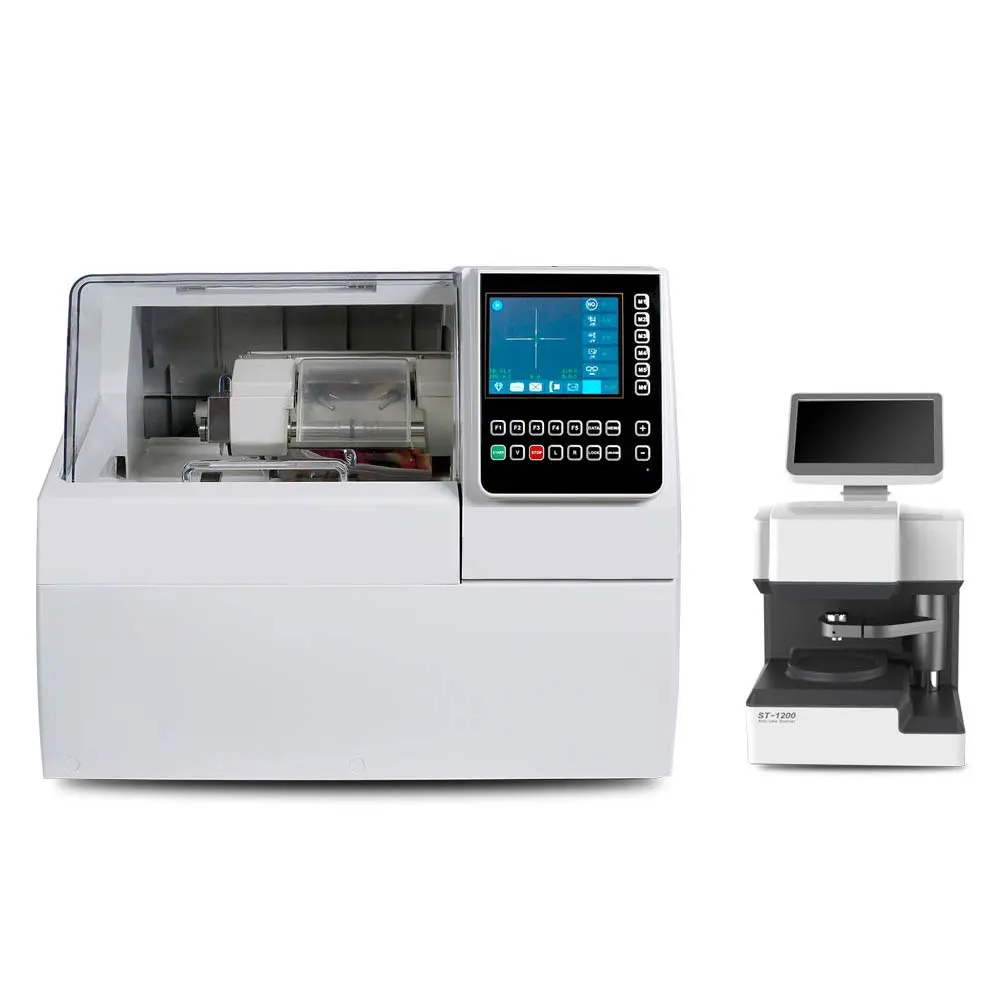
The lens edger machine is a specialized piece of equipment used in optical laboratories and shops to precisely cut, shape, and finish the edges of eyeglass lenses so they fit perfectly into a chosen frame. This process, known as lens edging or finishing, is a critical final step in creating prescription eyewear.

How a Lens Edger Works
The general process of using a lens edger (especially a modern, automatic one) involves several steps:
- Tracing: A frame tracer digitally scans the inside rim of the chosen frame to get its exact shape and dimensions.
- Marking and Blocking: The optical center and axis points of the lens blank are marked (using a lensometer), and then a “block” (a small puck with an adhesive pad) is attached to the lens to hold it securely in the edger’s chuck during the cutting process.
- Edging: The blocked lens is placed into the edger. Computer-controlled motors guide the spinning lens against a series of abrasive grinding wheels (often diamond-impregnated). Water is typically used as a coolant and to wash away debris (wet edgers).
- Finishing: Depending on the machine and desired result, the lens may undergo additional finishing processes:
- Beveling: Creating a V-shaped edge that fits securely into a full-rim frame’s groove.
- Grooving: Cutting a channel for the nylon string used in semi-rimless (supra) frames.
- Polishing: Buffing the edge from a frosted look to a clear, attractive shine, often used for high-index lenses.
- Drilling: Creating holes for rimless frames.
- Assembly: Once the edging is complete, the lens is removed from the machine, cleaned, and fitted into the frame
What Types of Lens Edgers Are Available?
Beginners often find the categories confusing, but the industry typically classifies edgers based on their processing capabilities.
Manual Edgers: These are typically smaller, hand-operated machines with a rotating abrasive wheel. The optician holds the lens against the wheel and manually guides it to the correct shape. They are highly labor-intensive and best for small workshops, custom jobs, or as a backup for emergency repairs.
Semi-Automatic Edgers: These machines offer some automated functions but still require some manual intervention from the operator. They balance cost and efficiency.
Automatic (Patternless) Edgers: These are the modern standard for most optical shops and labs. They link directly to a frame tracer and are fully automated, requiring minimal human input once programmed. They are highly accurate and efficient, capable of handling various lens materials (plastic, polycarbonate, high-index, Trivex, and glass) and complex jobs like drilling and advanced beveling.
Integrated edging systems: These units combine tracing, blocking, edging, and drilling into one workstation. They suit optical shops that need fast turnaround and limited bench space.
According to market data, With demand surging from both corrective and industrial optics, lens edger machines serve as the linchpin for ensuring precise geometry, optimal quality, and streamlined workflow within the global optical market. Industry transformation is propelled by automation, digital interfacing, and integrated maintenance systems. (Lens Edger Machine Market – Global Forecast 2025-2030).
Benefits of Using a Lens Edger
- Precision and Accuracy: Digital and automatic systems eliminate human error, ensuring the lens perfectly matches the frame specifications.
- Speed and Efficiency: On-site edging allows opticians to offer same-day service to patients, improving turnaround times and customer satisfaction.
- Versatility: Modern edgers can process a wide range of lens materials and complex shapes, offering greater customization options.
- Cost-Effectiveness: In-house finishing can reduce labor costs and material waste compared to sending jobs to external labs
Why Many Beginners Choose Shanghai LINK for Edger Equipment
Shanghai Link Instruments, a professional manufacturer of Ophthalmic Equipment and Optical Lab Machinery, provides edging systems designed for beginners and experienced operators alike.
Their factory integrates R&D, design, and production under one system, ensuring performance consistency across every unit. With ISO 9001, ISO 13485, CE, and FDA certifications, Shanghai LINK (linkeyegroup.com) supplies equipment to optical chains, hospitals, and training institutions worldwide.
Key advantages include:
- User-friendly interfaces suitable for beginners
- Stable motor and cutting control
- Multi-material compatibility
- Training support for new operators
- Long-life components and predictable maintenance cycles
- Balanced price-to-performance ratio
“Reliable edging machinery not only improves production speed but also protects the optician’s craftsmanship.”
— Prof. Liu R., Optical Engineering Specialist
Conclusion
A lens edger machine simplifies lens production, improves accuracy, and supports fast service in modern optical labs. It gives beginners a clear workflow to build practical skills and handle daily tasks with confidence. With reliable suppliers like Shanghai LINK Instrument providing stable and beginner-friendly systems, new optical shops and clinics can set up efficient operations quickly and deliver consistent results.


