
For small optical labs and independent practices, choosing the right auto lens edger is a critical business decision. In this blog, we’ll analyze the best options of auto lens edger for 2026, focusing on the specific needs of low-volume workplaces, and explain why brands like Shanghai LINK are becoming the preferred solutions for savvy business owners.
Why Auto Edgers Are Essential for Small Labs
Small labs often face tight schedules and limited space. Auto edgers provide:
- Consistent precision in lens edging
- Reduced manual labor, freeing technicians for other tasks
- Faster processing times, increasing daily capacity
- Compact designs suitable for limited workspace
Key Features Every Small Lab Needs
For a small optical lab, a good auto edger needs compactness, efficiency, versatility. Here are the non-negotiable features:
- Patternless 3D Tracing: Old-school manual templates are dead. Your edger must have an integrated or seamless connection to a 3D frame tracer. This reduces inventory (no patterns to store) and increases speed.
- Versatile Grinding: Support for all lens materials (CR39, PC, Trivex, High-Index) with multiple wheels.
- Compact Footprint: In a small shop, real estate is money. You need an “all-in-one” unit where the blocker, tracer, and edger fit on a standard optical bench.
- Internal Grooving & Safety Beveling: Sending lenses out just for grooving kills your turnaround time. A modern automatic edging machine must handle rimless and semi-rimless jobs internally.
Top Contender: Why Shanghai LINK Stands Out
While traditional European and Japanese brands command premium pricing, Shanghai LINK offers auto lens edger models that deliver 95% of the functionality at a fraction of the cost—a perfect formula for small labs.
The Value Proposition: Shanghai LINK ALE Series
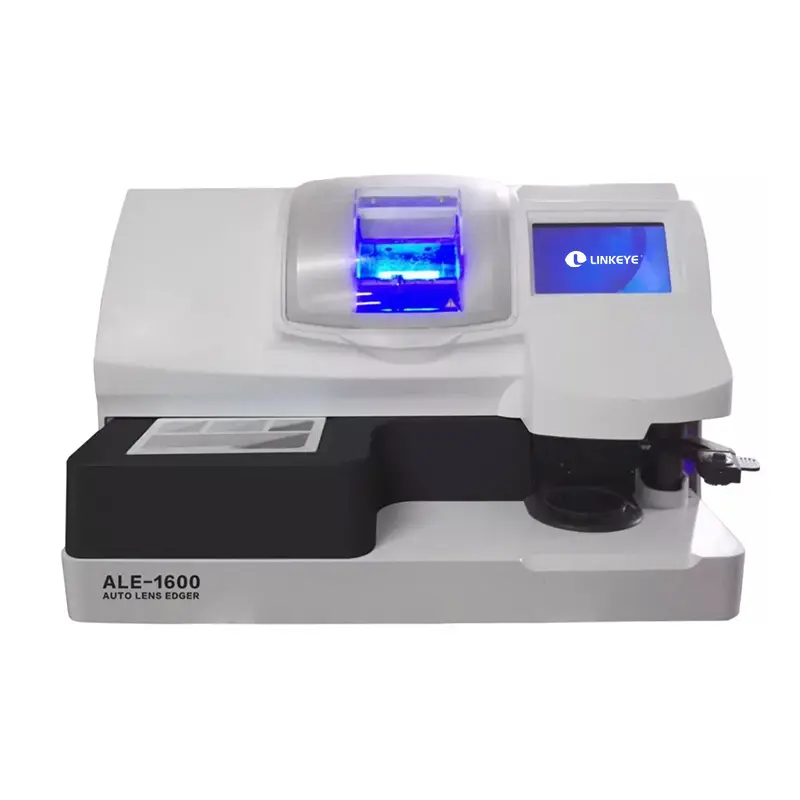
Models like the ALE-1600 and MOLO-1200 are designed specifically for versatility. Unlike basic edging systems, these machines often integrate advanced features usually reserved for top-tier units:
- Intelligent Groove Positioning: The software automatically calculates the optimal groove curve based on the lens thickness and frame curve, reducing the “spoiled lens” rate significantly.
- Retina-Level Touch Screens: The interface matters. Shanghai LINK machines typically feature large (7.0 to 10.4-inch) high-resolution touch screens. This reduces operator error by making job data clear and easy to modify.
- Robust Build Quality: Many LINK models feature all-aluminum body construction to prevent rust—a common killer of lab equipment in humid edging environments.
For a startup or a small clinic, a Shanghai LINK auto edger allows you to bring edging in-house with an ROI measured in months, not years.Shanghai LINK ALE-1600
A prime example of high-efficiency engineering for small spaces. Features rapid optical scanning and patternless operation.
ROI Analysis: Other Brands vs. Shanghai LINK
Let’s look at the numbers. A top-tier European optical lens edger can cost upwards of $30,000 to $50,000. For a lab doing over 50 jobs a day, this is acceptable. But for a small practice doing 10-15 jobs a day, that capital expenditure suffocates cash flow.
The Shanghai LINK Advantage:
- Lower Entry Cost: You can often setup a complete LINK finishing lab (Edger + Blocker + Tracer) for under $10,000 – $12,000 depending on the specific retailer and package.
- Cheaper Consumables: Replacement wheels and chucks for standard Asian-manufactured platforms are widely available and cost significantly less than proprietary parts from closed-ecosystem brands.
- Faster Break-Even: With a lower overhead, your “cost per job” drops immediately, allowing you to profit from in-house edging sooner.
Maintenance Guide: How to Keep Your Auto Edger Running?
Routine Maintenance (Before/After Use)
- Fuel & Oil: Use fresh, ethanol-free fuel with stabilizer; check and change oil frequently as per manual.
- Air Filter: Inspect daily, clean or replace if dirty to ensure proper airflow.
- Belts & Caster Wheels: Check belts for wear/tension and casters for smooth movement.
- Blade: Keep it sharp and check for damage or excessive play; adjust as needed.
- Cleanliness: Clean debris from engine, muffler, and around the blade area.
- Spark Arrestor: Keep the muffler’s spark screen clear of soot.
Troubleshooting Common Issues
Won’t Start/Runs Rough:
- Fuel Issues: Old fuel clogs carburetors; use fresh fuel and stabilizer.
- Carburetor: Clean it with carb cleaner, or adjust L (idle) and H (high-speed) screws (turn counter-clockwise to richen fuel).
- Spark Plug: Clean carbon, check gap, or replace if fouled.
- Fuel Filter: Replace if clogged (cannot see light through it).
Starts, Then Stalls:
- Spark Arrestor: Clogged screen restricts exhaust.
- Carburetor/Fuel: Fuel mixture issues or clogged passages.
- Low Compression: May indicate engine wear requiring rebuild.
Key Operational Tips
- Prime System: Pump the purge bulb a few times before starting.
- Choke: Use the “COLD START” setting for cold engines.
- Recoil Handle: Pull firmly but let it return slowly to avoid damage.
- Tilt Angle: Tilt 45 degrees after rain for easier edging in soft soil.
Conclusion
For the small lab owner, the “best” machine is the one that generates profit without causing headaches. While legacy brands offer prestige, Shanghai LINK offers performance that fits the budget of a growing business. By combining a LINK auto lens edger with a disciplined maintenance routine, you can produce factory-quality eyewear in a closet-sized lab, keeping your patients happy and your margins healthy.
FAQs
1. Is an Automatic Edging Machine Worth the Investment?
Fully automatic edge banding machines are the most advanced and efficient option for professional woodworking operations. These machines feature automated feeding, trimming, and finishing capabilities, reducing labor costs and increasing productivity.
2. How much training is required to operate an auto edger?
With intuitive interfaces, training typically takes a few hours.
3. What maintenance is needed for auto edgers?
Regular cleaning and periodic calibration are recommended.


