
The market in 2025 is dominated by fully automatic, patternless edgers that incorporate sophisticated 3D technology, integrated tracing, and smart software. The top machines are defined by their ability to handle the most complex lens materials (like Trivex and high-index), advanced coatings, and high-curve sport frames with speed and absolute precision. Here is a breakdown of the leading auto lens edger machines and what optical shops should look for when selecting equipment in 2025.
What Makes a Great Auto Lens Edger in 2025?
Priority will be given to products with the following characteristics:
- Stable cutting performance
- Accurate tracing for all lens materials
- Fast finishing speed
- Support for high‑curve and complex frames
- Low maintenance requirements
- Reasonable consumable costs
- Easy-to-use touchscreen software
Top Auto Lens Edger Machines for 2025
The automated lens edger market is highly competitive, led by a few global powerhouses that consistently drive innovation. While specific model names may evolve, the major industry players and their hallmark systems remain the gold standard.
| Manufacturer | Recommended System Line | Key Strength | Ideal For |
|---|---|---|---|
| Nidek (Santinelli) | LEXCE Trend / ME-1500 Series | Speed and Versatility | High-volume retail, complex drilling, same-day service. |
| Essilor Instruments | Mr. Blue 2.0 / Visionix VX40 | Precision and Integration | High-end fashion frames, wrap frames, seamless Visioffice integration. |
| Briot (Luneau Technology) | Emotion 2 / Perception 2 | User-Friendliness & Compact Design | Independent optical shops, entry-level in-house finishing. |
| Huvitz (Coburn Tech) | HPE-990 Series | Advanced Hydrophobic & High-Curve Lenses | Labs specializing in premium coatings and sports eyewear. |
| Shanghai LINK | ALE-1000B / ALE-1600 | High-Precision Automation & Integrated Workflow | Optical labs and retail shops requiring smart processing, compact integration, and versatile material compatibility. |
1. Nidek (Santinelli): Fast and Versatile
Known for high speed and strong performance on complex shapes.
ME-1500 / LEXCE Trend: ME-1500 offers full 3D drilling; LEXCE Trend combines tracing and imaging in one unit.
Key Points: AI alignment, stable chuck pressure, cycle times often under 75 seconds.
2. Essilor Instruments: High-Precision Fitting
Focused on accuracy and seamless integration with Essilor systems.
Mr. Blue 2.0: Hybrid grinding and advanced centering, with a Sun & Sport version for wrap frames.
Key Points: Strong ecosystem compatibility and flexible two-piece setup.
3. Briot (Luneau): Compact and Easy to Use
A practical choice for entry-level and mid-volume labs.
Emotion 2 / Perception 2: Handles most lens types; GraviTech® enables tracing without demo lenses.
Key Points: Reliable, compact, and low-maintenance.
4. Huvitz (Coburn): Stable on Coated Lenses
Built to prevent slippage on hydrophobic and high-curve lenses.
HPE-990: Reinforced motor and adaptive chuck for stable cutting.
Key Points: Deep Step Bevel, multiple edging styles, controlled final-stage processing.
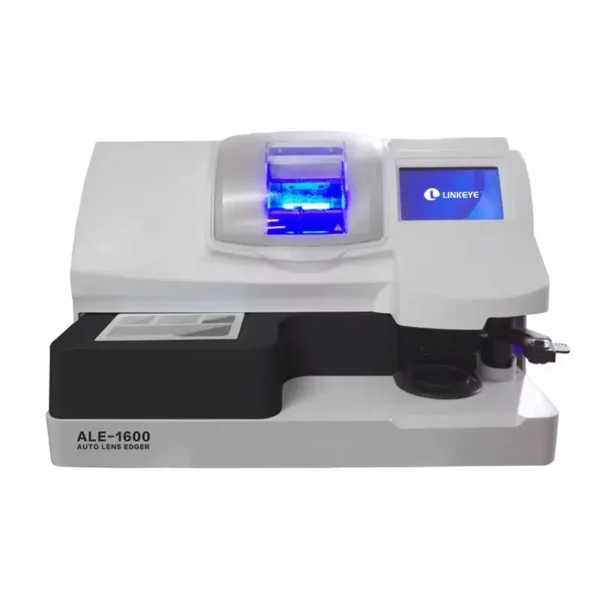
5. Nidek (Santinelli): (https://link-eyecare.com) – ALE-1000B / ALE-1600
High-precision automated edging with an integrated, compact workflow. Ideal for optical labs and retail shops needing efficient processing and broad material compatibility.
· Automatic lens centering, blocking, and edging – all-in-one system
· Supports bevel, groove, and polish functions for different frame styles
· Smart shape memory and data storage for repeat orders and fast workflow
· Compatible with plastic, polycarbonate, and high-index lenses
· Large LCD touchscreen for easy operation and visual monitoring
· Clean cutting system with minimized noise and water control
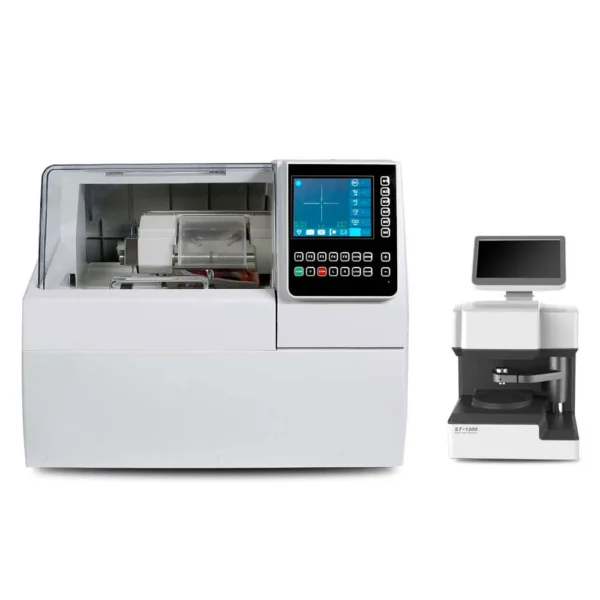
· 3-in-1 design, combines scanner, centering system, and edger for efficient operation and space-saving setup.
· Optical scanner, delivers high-speed tracing in just 3 seconds with greater accuracy and lower failure rate.
· Digital template editing, allows precise control of length, width, axis, and decentration.
· High-power motor, ensures smooth edging of various lens materials including PC, HI, TR, and glass.
· Drop-speed protection, adjusts lens descent to safeguard fragile and premium lenses.
· Open menu system, simplifies after-sales service and technical maintenance.
Price Trends for Auto Lens Edgers in 2025
Typical 2025 pricing ranges:
• Entry‑level compact edgers: USD 1,000–4,000
• Mid‑range digital edgers: USD 4,000–8,000
• High‑performance lab edgers: USD 8,000–15,000+
For most retail optical shops, mid‑range systems offer the ideal balance between price and performance.
Why Many Optical Shops Choose Shanghai LINK Instruments
Shanghai LINK Instruments provides globally certified, durable, and competitively priced Auto Lens Edger machines suitable for retail optical stores and small finishing labs. Key benefits include:
• Stable motor engineering
• Accurate 3D tracing
• Long‑lasting diamond wheels
• Software designed for quick operation
• Good after‑sales support and spare‑parts availability
The combination of affordability and dependable performance makes these machines popular among emerging optical businesses.
Conclusion:
The “best” edger is the one that aligns perfectly with your practice’s volume, specialty, and budget.
If your focus is high-volume production and handling every complex lens that walks in the door, invest in a Nidek or Shanghai LINK system.
If you are an independent optical shop looking for a cost-effective system that delivers quality and reliability, a Briot or a mid-range Huvitz/Coburn model offers the best balance of features and value.
FAQs
What is the typical auto lens edger price in Pakistan?
In Pakistan, auto lens edgers generally range from mid-level entry models to advanced patternless machines. Prices vary based on specifications, brand, and import duties.
What is the auto lens edger machine price in India?
In India, pricing depends on the model type, automation features, and service availability. Entry-level semi-auto machines cost less, while fully automatic and patternless units fall into a higher range.Semi Automatic Lens Edger generally at ₹ 72000/piece.
Which is better: semi auto or fully automatic lens edger?
Semi-auto models are more economical and suitable for low-to-mid volume shops, while fully automatic machines provide faster workflow, fewer errors, and higher consistency for busy optical labs.
Are auto lens edgers suitable for all lens materials?
Automatic lens edgers can be used to process a large variety of lens materials, including plastic, trivex, polycarbonate, high-index, and glass.
