
Instroduction
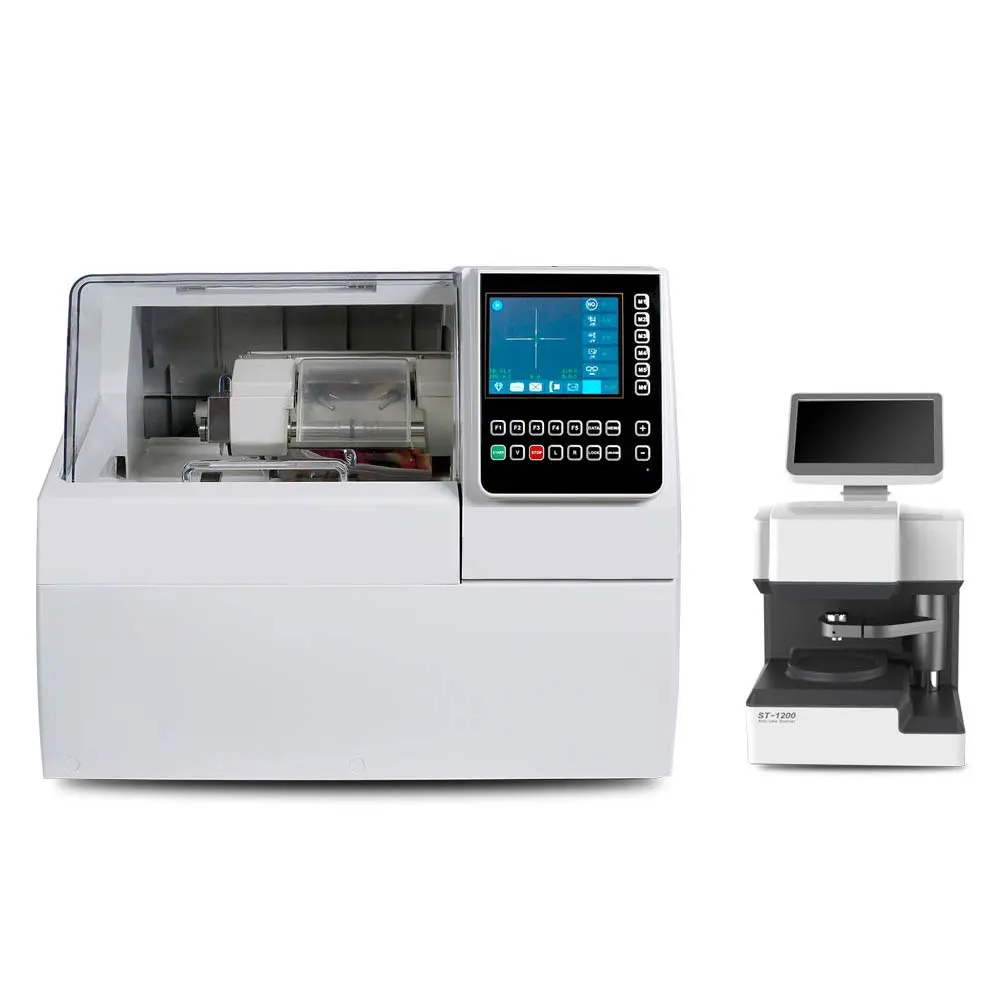
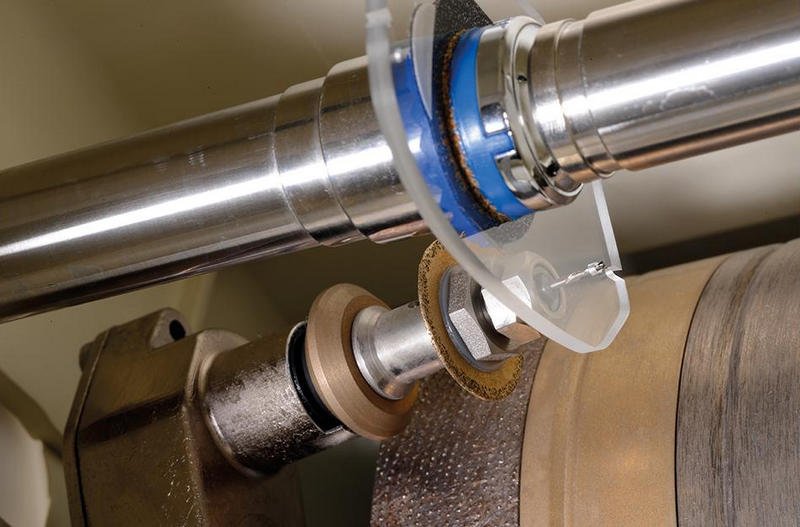
An automatic edging machine is one of the core pieces of equipment in an optical finishing workflow. It shapes ophthalmic lenses according to frame data and, depending on the configuration, may also perform beveling, grooving, polishing, chamfering and drilling. Machining precision, supported lens materials, tracing methods, level of automation, maintenance requirements, consumables, and technical support all influence the equipment’s actual performance.
For buyers comparing suppliers, the following seven manufacturers represent different approaches to automatic lens edging—from conventional grinding systems to integrated patternless and blockless milling solutions.
Automatic Edging Machine Manufacturers at a Glance
| Manufacturer | Representative Products | Main Strength |
|---|---|---|
| LINK Instruments | ALE-1600, ALE-3200, MOLO-1200 | Multiple configurations and OEM/ODM flexibility |
| NIDEK | LEXCE plus, ME-1 | Integrated lens finishing |
| Essilor Instruments | Mr Blue 2.0, Pro-E | Advanced finishing workflow |
| Huvitz | HPE-990 | Complex and high-curve lens processing |
| MEI | EasyFit Trend | Blockless dry milling |
| Visionix / Briot | Briot Evolution, Couture | Tracing and shape management |
| Coburn Technologies | HPE / Perfecto systems | Complete in-office finishing solutions |
This list should not be interpreted as an absolute performance ranking. The appropriate manufacturer depends on the lenses, frames and finishing processes required by the buyer.
1. LINK Instruments
LINK Instruments manufactures optometry, ophthalmic and optical lab equipment, including a dedicated range of automatic lens edging systems.
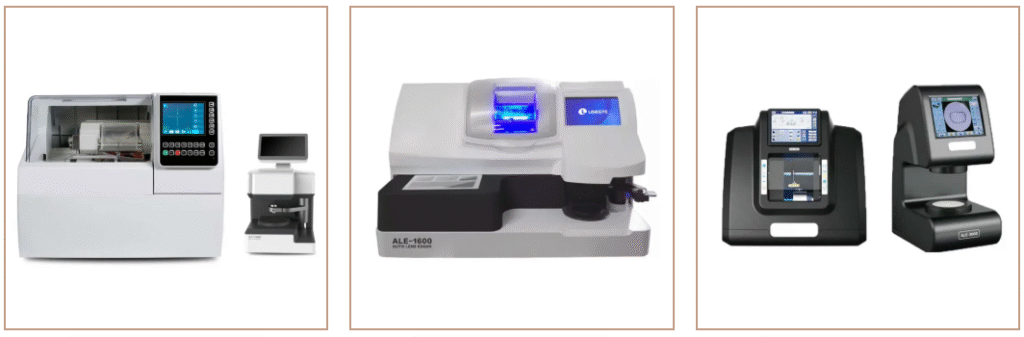
Its current Auto Lens Edger portfolio includes eight models:
The range covers different levels of integration and processing capability.
The ALE-1600, for example, uses a 3-in-1 design integrating the scanner, centering system and edger. Its optical scanner can complete tracing in approximately three seconds, while digital template editing allows adjustment of length, width, axis and decentration.
For more demanding processing, the ALE-3200 provides 3D intelligent scanning and supports beveling, flat edging, grooving, polishing and chamfering. Published specifications include ±0.05 mm size accuracy and ±1° axis-angle accuracy.
Key strengths:
- Multiple automatic edging machine configurations
- Patternless lens processing
- Integrated scanning and centering options
- Processing of common ophthalmic lens materials
- Models for different finishing requirements
- OEM/ODM support
LINK is particularly worth evaluating when buyers want to compare several configurations from the same manufacturer rather than adapt their workflow to one fixed machine.
2. NIDEK
Japanese manufacturer NIDEK has an established portfolio of ophthalmic lens-finishing equipment.
Its lens edging range includes systems such as the ME-1 Multifunction Edger and LEXCE plus patternless edger, alongside system and automated edging solutions.
The LEXCE plus combines lens finishing with an integrated blocker and optional tracer configurations. The ME-1 is positioned toward multifunction processing and more complex finishing requirements.
Key strengths:
- Patternless edging
- Integrated finishing workflow
- Multifunction processing
- Automated edging systems
- Established optical equipment ecosystem
NIDEK is worth considering for buyers who prioritize an established finishing platform and integrated workflow.
3. Essilor Instruments
Essilor Instruments has a long history in ophthalmic lens processing and offers integrated finishing systems for optical laboratories and in-house lens production.
Representative solutions include Mr Blue 2.0 and Pro-E.
Depending on configuration, its finishing systems combine tracing, centering, blocking and edging with functions such as beveling, polishing, grooving and drilling.
Key strengths:
- Integrated tracing and finishing
- Advanced centering
- Complex finishing functions
- High-curve processing options
- Broad optical ecosystem
Essilor Instruments is particularly relevant when sophisticated finishing capabilities and integration are higher priorities than minimizing initial equipment investment.
4. Huvitz
Huvitz manufactures ophthalmic and optometric equipment alongside automatic lens edging systems.
Its HPE-990 is designed for more demanding finishing jobs, including hydrophobic, coated and high-curvature lenses.
The system includes technologies intended to improve clamping stability and processing control. It also supports functions such as Deep Step Bevel and integrated drilling.
Key strengths:
- Hydrophobic lens processing
- High-curve lens capability
- Stable lens clamping
- Deep Step Bevel
- Integrated drilling
- Complex finishing applications
Huvitz deserves consideration when specialty lenses and challenging frame designs represent a significant part of the daily workload.
5. MEI
Italian manufacturer MEI approaches lens edging differently from conventional grinding-wheel systems.
Its EasyFit Trend uses high-precision milling technology together with Dry Cut and No Block systems.
Dry Cut eliminates the water normally required for conventional lens grinding, while No Block eliminates traditional blocks and pads from the workflow.
The system also incorporates tracing and quality-control functions.
Key strengths:
- High-precision milling
- Dry lens cutting
- Blockless processing
- Integrated tracing
- Automatic calibration
- Quality-control integration
MEI is particularly relevant when a buyer is considering a different production workflow rather than simply replacing an existing conventional edger.
6. Visionix / Briot
Visionix offers lens-finishing equipment through its Briot and Weco product families.
Systems such as Briot Evolution combine frame tracing and lens finishing, with capabilities including shape modification, beveling, grooving and drilling.
Tracing is an important part of the Briot approach, making these systems relevant when accurate frame-shape acquisition and customized finishing are regular requirements.
Key strengths:
- Optical frame tracing
- Shape modification
- Beveling and grooving
- Drilling
- Flexible finishing workflow
Visionix/Briot can be worth evaluating for optical businesses handling varied frame designs and requiring flexible shape management.
7. Coburn Technologies
Coburn Technologies supplies equipment across several stages of ophthalmic lens production, including surfacing, coating and finishing.
Its finishing portfolio includes automatic edgers as well as tracers, blockers and supporting lab equipment.
This broader equipment range can be useful when a buyer is establishing or upgrading a complete in-house finishing workflow rather than purchasing only one machine.
Key strengths:
- Automatic lens finishing
- Tracing and blocking equipment
- Multiple finishing configurations
- Supporting lab equipment
- Technical and consumable support
Exact model availability should be checked for the buyer’s market because regional product portfolios can differ.
How to Compare Automatic Edging Machine Manufacturers
Manufacturer reputation alone should not determine the purchase.
Start by defining the actual jobs the machine needs to complete:
Lens material → frame type → daily volume → tracing → centering/blocking → beveling → grooving → polishing → drilling → service requirements.
Then compare manufacturers against the same requirements.
| Factor | What to Check | Why It Matters |
|---|---|---|
| Lens Compatibility | CR-39, PC, Trivex, high-index, glass | Determines usable applications |
| Tracing | 2D/3D, integrated or separate | Affects frame-shape workflow |
| Processing Accuracy | Size and axis specifications | Influences lens-to-frame fitting |
| Finishing Functions | Bevel, groove, polish, drill | Determines which jobs can be processed |
| Automation | Tracing, centering and blocking | Influences labor and throughput |
| Consumables | Wheels, blocks, pads and filters | Affects operating cost |
| Maintenance | Calibration and replacement parts | Influences equipment uptime |
| Support | Training and troubleshooting | Important after installation |
A small finishing operation processing standard CR-39 and polycarbonate lenses does not necessarily need the same machine as a lab regularly handling high-index, hydrophobic, rimless and high-curve jobs.
For smaller operations, see What Is the Best Auto Edger Machine for Small Labs?.
For additional model comparisons, read Best Auto Lens Edger Machines for Optical Shops.
Why Consider LINK Instruments?
After comparing established automatic edging machine manufacturers, LINK Instruments is particularly worth considering for buyers who need a combination of model selection, practical processing functions and B2B customization.
Multiple Models Instead of One Fixed Configuration
LINK currently offers eight Auto Lens Edger models.
This allows buyers to select equipment according to the required workflow instead of paying for functions they may not use.
For example:
- ALE-520 – supports CR-39, glass and PC lens processing with sharp edge, flat edge and flat-edge polishing functions.
- ALE-1000 – integrates automatic centering, blocking and edging and supports beveling, grooving and polishing.
- ALE-1600 – combines scanner, centering and edging in a compact 3-in-1 system.
- ALE-3200 – adds 3D intelligent scanning and more advanced processing functions for demanding optical lab applications.
Specifications Buyers Can Compare
Rather than relying only on descriptions such as “high precision,” LINK publishes measurable specifications for several models.
The ALE-3200, for example, specifies:
- Size accuracy: ±0.05 mm
- Axis angle: ±1°
- Glass, plastic and polycarbonate processing
- Beveling
- Flat edging
- Grooving
- Polishing
- Chamfering
These specifications give buyers concrete values to include in supplier comparisons.
Integrated Workflow Options
For buyers trying to reduce separate equipment and operator steps, the ALE-1600 integrates scanning + centering + edging.
Its optical scanner is specified to complete tracing in approximately three seconds, while the digital template system provides adjustment of length, width, axis and decentration.
This type of configuration can be useful when bench space and workflow efficiency are important.
B2B and OEM/ODM Sourcing
LINK Instruments positions itself as a manufacturer rather than only an equipment reseller. Its broader business covers optometry, ophthalmic and optical lab equipment, with products supplied internationally.
For distributors and volume procurement projects, this makes it possible to discuss requirements beyond a standard single-machine purchase, including:
- Equipment configuration
- OEM/ODM requirements
- Branding
- Order quantity
- Destination-market requirements
- Documentation
- Accessories
- Spare parts and after-sales support
The exact customization, certification, MOQ and commercial terms should still be confirmed for the selected model and destination market before ordering.
For buyers comparing established brands with factory-direct sourcing options, LINK therefore provides another practical route: select the required processing capability first, then request a configuration based on the actual lens-finishing workflow.
→ Explore LINK Instruments Auto Lens Edgers
Conclusion
The seven manufacturers above represent different approaches to automatic lens finishing.
NIDEK and Essilor Instruments provide established integrated finishing platforms. Huvitz focuses on more demanding lens applications. MEI uses a distinctive dry, blockless milling workflow. Visionix/Briot emphasizes tracing and flexible shape management, while Coburn provides equipment across a broader optical lab workflow.
LINK Instruments offers another option for buyers who prioritize multiple automatic edger configurations, integrated processing options, published technical specifications and OEM/ODM sourcing flexibility.
FAQs
Which automatic edging machine manufacturer should I choose?
Choose according to the actual finishing workload. Compare supported lens materials, frame types, processing accuracy, tracing, finishing functions, automation, consumables and technical support rather than relying on brand recognition alone.
What specifications should I compare before buying?
Important specifications include lens size range, supported materials, size and axis accuracy, tracing method, beveling and grooving functions, drilling capability, processing speed, power requirements and calibration procedures.
Should I test an automatic lens edger before a bulk order?
Yes, For multi-unit, distributor or OEM orders, testing representative lenses and frames is useful. A test run lets you check cut accuracy, bevel quality, rimless drill precision, and machine stability. This prevents costly ruined lenses and production delays for your lab.
