
An auto edger machine handles CR-39, polycarbonate, Trivex and high-index lenses, but each material cuts differently. During operation, select the appropriate grinding wheel type, feed rate, and coolant based on the lens material, and clean the water tank, grinding wheel, and chuck at established intervals. That routine prevents chipped bevels, axis drift and early wheel wear.

Why Lens Material Decides How Your Auto Edger Machine Performs
Lens material dictates how an auto edger machine cuts, grinds, and finishes the lens because different polymers and minerals react uniquely to heat, pressure, and abrasive wheels.
The spectacle lens market was worth about USD 60.47 billion in 2025 and is forecast to reach USD 78.03 billion by 2031. Mordor Intelligence.[1] More lens types means more variety crossing your wheel each day. Polycarbonate alone remains a fixture in pediatric and safety eyewear. Mordor Intelligence.[1]
What changes from lens to lens
- Refractive index and edge thickness
- Thermoplastic or thermoset structure
- Brittleness at thin edges
- Coating grip on the chuck
CR-39 has a refractive index of 1.498; polycarbonate sits at 1.586. Master Eye Associates.[2] Polycarbonate is an injection-moulded thermoplastic, while Trivex behaves partly like CR-39 and partly like polycarbonate. Optician Online.[3] Thermoplastics soften under friction. So a worn wheel on polycarbonate smears instead of cutting.
Material-by-Material Settings for an Optical Edger Machine
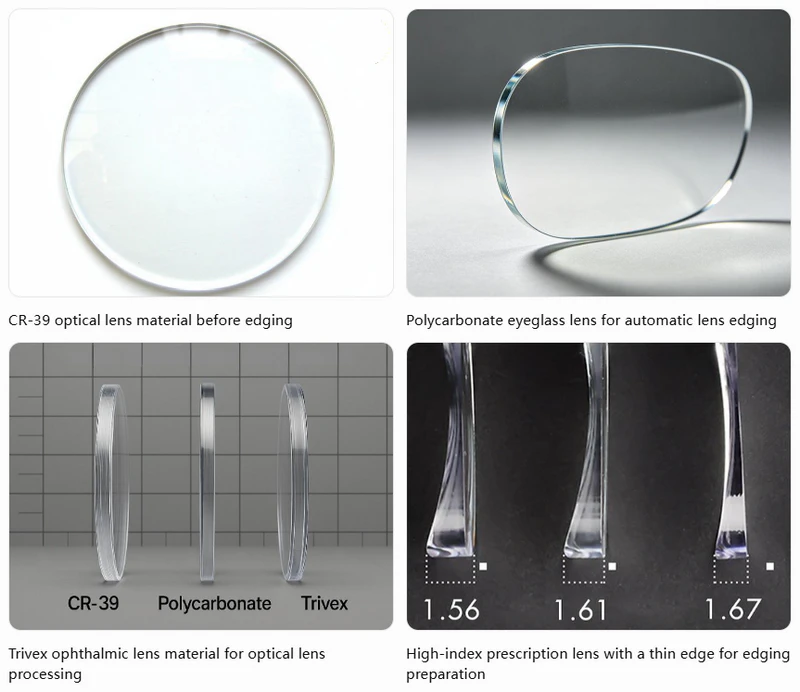
Before changing wheel or feed speed, check this table:
| Lens material | Refractive index | Edging behavior | Watch for |
|---|---|---|---|
| CR-39 | 1.498[2] | Forgiving, cuts clean | Complacency when switching materials |
| Polycarbonate | 1.586[2] | Soft, heat-sensitive | Gummed wheels, burnt edges |
| Trivex | Mid-range | Close to polycarbonate | Heat build-up, dull wheels |
| High-index plastic | 1.64–1.74[2] | Brittle at thin edges | Chipped safety bevels |
Polycarbonate and Trivex: Soft Cutters Need Sharp Wheels
Cut slowly. Keep coolant clean and cold. Dress the wheel before the first job of the day. A gummed wheel drags the lens, heats the edge and leaves a cloudy bevel, and by then the damage is done.
High-Index and CR-39: Where Chips and Slips Show Up
- 1.67 and 1.74 lenses chip at thin safety bevels, so lower the feed on thin edges.
- AR-coated surfaces slip on the chuck; replace worn lens pads and clamp to the manual’s spec.
- Glass needs its own wheel and a slower feed.
- CR-39 forgives most mistakes. Don’t let that habit follow you to polycarbonate.
Edge quality matters beyond looks. U.S. rules require lenses to withstand a 5/8-inch steel ball dropped from 50 inches. U.S. Food and Drug Administration.[4] The FDA also states that impact-resistant is not the same as shatterproof. U.S. Food and Drug Administration.[5] A chipped bevel or burnt corner is exactly the weak spot you don’t want on a lens that’s expected to pass.
Routine Care Guide for an Automatic Edging Machine
Use one fixed checklist, because skipped steps show up on the lens first.
Daily
- Check coolant clarity and level
- Wipe chuck, pads and sensor window
- Inspect wheels for gumming or glazing
- Run the first job as a test
Weekly
Flush the tank, clean the filter and dress the wheel. Dirty coolant carries swarf back onto the lens. The result: fine scratches and uneven bevels that look like a calibration fault but aren’t.
Monthly
- Verify axis on finished lenses with a lensmeter
- Check chuck alignment and clamping force
- Review the wheel wear log and replace before cut quality drops
Yes, it’s boring. It’s also cheaper than remaking a 1.74 lens.
Choosing an Auto Lens Edger Machine for Mixed Materials
Before buying, confirm these points:
Material range and wheel options
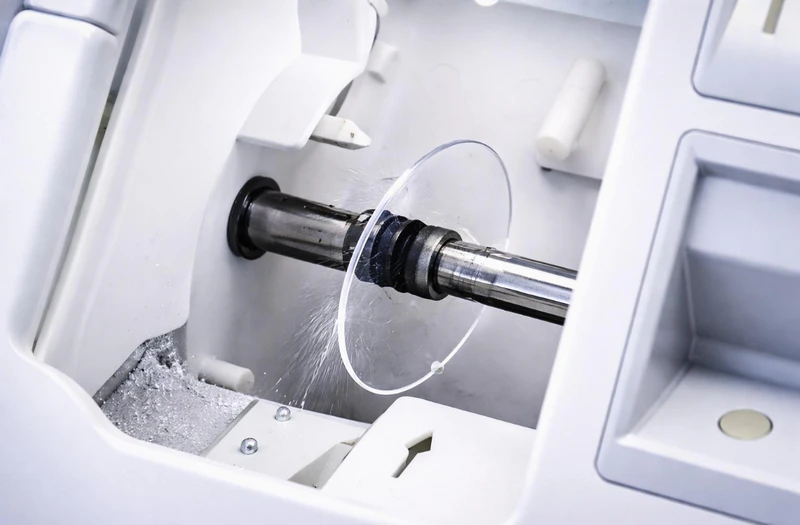
Ask the supplier which materials the automatic edging device is built to process and which wheels it ships with. LINK states its edgers cover CR-39, polycarbonate, Trivex and high-index lenses.
Process coverage
- Beveling
- Grooving
- Polishing
- Chamfering
LINK’s ALE-3200 covers all four. The ALE-3500 adds a 10.4-inch touchscreen and template storage, and the ALE-3000 uses dual water jets for cooling.
Fit for your lab size
Running a small shop? Read our breakdown of the best auto edger machine for small labs. New to edging? Start with what a lens edger machine is.
Best Pick for Labs Cutting Mixed Materials
Start with the ALE-3200 if you need full process coverage, and the ALE-3500 if template storage and a larger screen matter more. Both sit inside LINK’s range of auto lens edger models, built in Suzhou under ISO 9001, ISO 13485 and CE certification. Not sure which fits? Contact LINK Instruments for a quote, a sample purchase or a remote video demo with operator training.
FAQ
1. Can one auto edger machine cut polycarbonate and high-index lenses?
Yes, a single modern automatic lens edger machine can cut, shape, bevel, and polish both polycarbonate and high-index lenses (such as 1.67 and 1.74 indices).
2. How often should coolant be changed in an automatic edging machine?
Coolant in an automatic edging machine (such as those used for glass or precision milling) should typically be changed every 6 to 12 months, or regularly based on water/fluid circulation and contamination levels.
3. Why do polycarbonate lenses burn or gum up the wheel?
Polycarbonate lenses burn or gum up the wheel primarily due to friction-induced heat combined with the material’s thermoplastic properties. Unlike CR-39 plastic or glass, polycarbonate responds uniquely to the mechanical pressures of an optical edger.
4. What causes chipped bevels on high-index lenses?
Chipped bevels on high-index lenses happen because the material is more brittle and subject to physical or mechanical stress during cutting, fitting, or daily wear. Slow the feed and replace worn wheels.
5. Does LINK offer demos or samples before purchase?
Yes. LINK offers sample purchases, remote video demos and installation training on request.
References
[1] Mordor Intelligence. Spectacle Lens Market Size and Share. 2025 market data and 2026–2031 forecast.
[2] Master Eye Associates. Eyeglass Lens Materials. Accessed 2026.10.12.
[3] Optician Online. Optical Properties of Lens Materials 2. Accessed 2026.10.12.
[4] U.S. Food and Drug Administration (via eCFR). 21 CFR § 801.410, Use of Impact-Resistant Lenses in Eyeglasses and Sunglasses. Accessed 2026.10.12.
[5] U.S. Food and Drug Administration. Impact-Resistant Lenses: Questions and Answers, Guidance for Industry and FDA Staff. Accessed 2026.10.12.
